Precious Insight Into The Wonder Of Wath
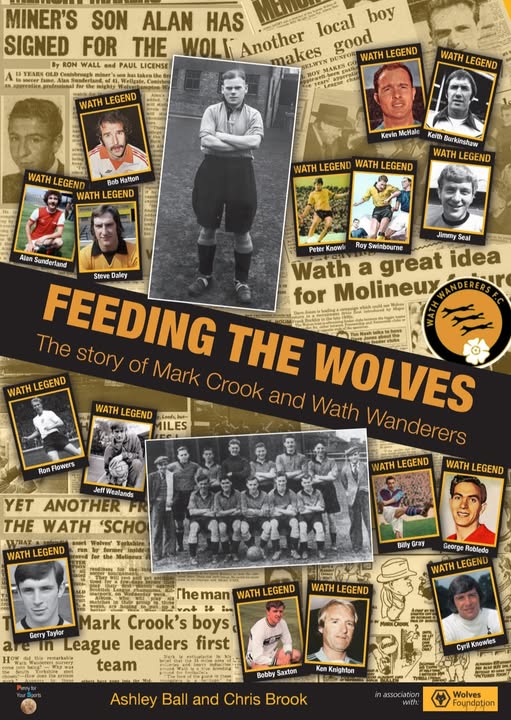 For four decades, many of the best young footballers in South Yorkshire and beyond were sent down to Wolverhampton.
Now, another half a century or so on, an outstanding book detailing the whole extraordinary operation has made the same journey.
Think 1966 World Cup squad member Ron Flowers, FA Cup final match-winner Alan Sunderland, scourge of Honved Roy Swinbourne, England star-in-the-making Peter Knowles and one-time record British buy Steve Daley and it is clear we are talking here about an elite group of players.
Throw in Bob Hatton, Gerry Taylor, Ken Knighton, 1960 FA Cup finalist Barry Stobart, Jim Barron, Geoff Sidebottom, Jeff Wealands, Martin Patching and 1953-54 League title winner John Short as well and the overwhelmingly positive impact of the influx is further underlined.
All came from Wath Wanderers, the remarkable nursery club overseen by early 1930s Molineux winger Mark Crook. And there could have been more huge names heading this way.
Feeding The Wolves (published by Penny For Your Sports) tells us that England trio Alan Ball, Terry Cooper and Cyril Knowles were each on the radar of the Yorkshire-based Wanderers. The phenomenal George Robledo, too. The book also floats the intriguing notion that Bobby and Jack Charlton caught the eye of Crook and his men before signing for Manchester United and Leeds instead.
This is one seriously busy and informative publication, superbly designed and packed with hundreds of photographs and as many interviews with men who, as teenagers, were dropped on to the rapid conveyor belt and, in many cases, dropped off it if they didn’t measure up.
The best of them were invited for closer scrutiny in Wolves’ junior teams, so the long list of arrivals in these parts also included Dave Galvin, Ian Arkwright, Jimmy McVeigh, Granville Palin, Mick Kent, Bobby Saxton, Jimmy Seal, Paul Walker and David Thompson. What a supply line it was!
An amazing 114 players from Wath graduated to playing in professional football and the nursery produced an average of more than three pros a year for the paid ranks. What figures!
“This is the finest place in the world to find footballers,” Crook once said of his native South Yorkshire. He might also have said that the area’s work options encouraged a certain extra will to win among his lads.

We have heard before from Barnsley boy Mick McCarthy that it was a football career or life down the pit for him, so there was every incentive to tackle harder, jump higher, run faster and shoot straighter.
McCarthy has written the foreword for this fine 178-page publication, which contains some rare gems.
Like how inside-right Arnold Stephens, who did not graduate as far as Wolves’ first team, once had a visit from two Glasgow police officers during his subsequent career north of the border and received the unwelcome information that a military escort was on the way as he had gone AWOL from the armed forces.
And there is a did-he-didn’t-he discussion over whether Alan Sunderland sat next to the League Cup silverware on the sofa at the Crooks’ home after featuring in the final victory over Manchester City in 1974.
This is essential reading for anyone interested in Wolves’ history and we recommend it very highly to our readers. There is so much to be learned and taken from it.
A common theme of the text, of course, is the spotlight on Crook, as provided by the memories of so many of the interviewees. He played 81 first-team games for Wolves, scoring 16 goals, and also played for Blackpool, Swindon and Luton in his useful playing career.
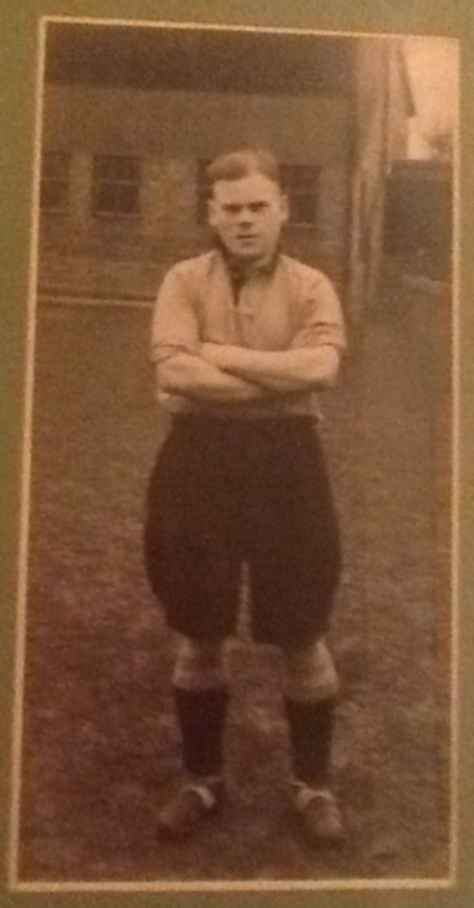
But it’s for his work as a finder and developer of players over the following decades that he is best remembered around Molineux.
And this book – written by South Yorkshire duo Ashley Ball and Chris Brook in association with the Wolves Foundation – gives us a pretty clear impression of his appearance and personality.
He was a small, stocky man, who favoured wearing a flat cap and was often behind the wheel of a nice Volvo when ferrying lads to practice matches. Oh…..and he was inclined to smell of fish and chips or even greyhounds; one provided him with a day job, the other were his passion away from football.
Many’s the time he apparently reached into his pocket, pulled out a hefty wad of notes and peeled off a fiver for a lad who impressed. ‘Boot money’ without the boots! Those who didn’t meet with his approval might have been told to find their own way home.
Feeding The Wolves is available in Wolverhampton city centre from Waterstone’s and Ron Flowers’s sports shop and can be ordered post-free for £20 from www.tinyurl.com/crookwwfc – read it and marvel.