

Billy Wright and Bert Williams were the glamour names among those whose job it was to keep goals out at one end.
At the other, there were international wingers, inside-forwards and no 9s aplenty who succeeded handsomely in their task to create and score them.
And, in between the two departments were wing-halves like Flowers, Slater and Clamp – for so long seen as the powerful ‘engine room’ of Stan Cullis’s most successful teams.
When we are harking back, though, to 1953-54 and the men who brought the League Championship silverware to Molineux for the first time, the name of John Short is not generally among those we quickly think of.
The Barnsley-born full-back won no England honours and didn’t stay around to see and help the club become champions in back-to-back seasons at the end of the decade.
But he was a First Division title winner and often an automatic pick when Wolves overcame Albion in all-West Midlands race for the top prize 72 seasons ago.
“That medal was his pride and joy,” his son, Ken, recalled. “Our mum used to wear it on a necklace until she was talked around! Dad played in the same defence as the England captain but spoke about having lots of great mates at Wolves and about living in digs down there in his early years in the game.
“Playing in what was one of the best teams in the country was a huge thrill to him, as was the chance to go on tour to South Africa with them in 1951. Most people just didn’t travel abroad then, so he felt very lucky to have spent a few weeks over there. He entertained us with stories when we were growing up and had one about how their Jeep was charged by a rhino when they were out on a safari.”
Short came through the famous Mark Crook nursery in South Yorkshire but only after dabbling with an altogether different career. From school, he followed the path taken by many Barnsley lads by heading to the local Dearne pit to earn a living.
Fortunately, his talents on the pitch were soon spotted and he signed at Molineux in 1948. Up against the likes of Terry Springthorpe, Larry Kelly and Roy Pritchard in his formative seasons in the professional game, he had to wait for his first-team debut.
But what a start he had when it came along! He was thrown in for the first time for the 3-1 home win over Albion in December, 1950 and went on to make 25 senior appearances in that breakthrough season, including seven FA Cup games out of seven in a run to the semi-final.
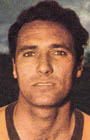
Wolves had been a club on the brink of something memorable ever since they finished League and Cup runners-up in 1938-39 and Short, having witnessed the 1949 FA Cup triumph at close quarters, had a substantial role in their on-going emergence.
He played 26 games in 1951-52, then 29 in 1952-53 and 27 in the big season of 1953-54 – all in the no 2 shirt. But Ken added: “He was a forward when he first went to Wolves.
“Stan Cullis converted him to a full-back but he still scored a couple of goals in one game against Manchester City and Bert Trautman.”
That brace was in an FA Cup third-round replay at Molineux in 1951-52 when he and Jimmy Mullen shared the goals in a 4-1 victory over opponents who had regained their top-flight status the previous spring.
Before Short even got his hands on a League winners’ medal, though, his Molineux story was unravelling. He lost his place for the last third of the campaign to Eddie Stuart and perhaps saw the writing on the wall with the burly South African quickly making himself at home in the first team.
Short wasn’t selected again at that level following a 4-2 defeat at Chelsea on February 13, 1954 that stood as the last of his 107 League and Cup outings for the club.
He was transfer-listed in the May and sold early the following month to Stoke, who were managed by another former Wolves full-back, Frank Taylor.
“Mom and Dad married in Dearne on March 3, 1956, with all the usual wedding-day trimmings…..except that Stoke sent a car to take him straight back to play for them that afternoon!”

Thereafter John moved to Barnsley for a four-season stint and more than 100 League matches, including a year as captain.
The family’s connection with professional football might have had other chapters, with eldest offspring Ken spending a couple of days training at Wolves in 1974 – “John Richards was with us youngsters as he was on his way back from injury and was God!” – and younger brother Stephen, a good friend of Gordon Cowans, had a couple of years at Villa that took him close to the first team.
“Stephen was a proper player with a footballer’s brain,” Ken said. “I had nothing like his talent but was quite good at stopping those who did have have some.”
John coached at Barnsley after a back injury ended his playing career and was also in the backroom team at Sheffield United, where he was the first man to meet Tony Currie at the city’s railway station when the future England midfielder arrived there as a nervous youngster from Watford.
Football didn’t make Short Snr a wealthy man. He never owned his own house and went back to the pit after the game had finished with him, albeit in a management position above ground.
Tragically, he died in 1976 aged only 48 after playing in a Charlie Williams charity match in Barnsley. He felt unwell in the dressing room but stubbornly refused an ambulance and passed away later that day.
“I played alongside him in quite a few games of that type, me at centre-half and him at right-back,” Ken added. “It’s surprising I didn’t play in that match – I must have had something else on.
“I remember one ex-player saying they didn’t know anyone who was harder to knock off the ball than he was. He was 5ft 10in and powerfully built and I just wish I had seen him play in his professional career but I didn’t arrive until he was nearly 30.
“One thing I did see for myself was that he was totally ambidextrous. He was every bit as good with his left foot as his right and could play snooker or bat equally well on either side. He didn’t show off about it…..he was just a natural.”
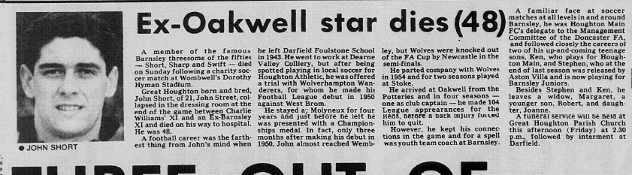 John Short is the least celebrated of a trio of title winners from Wath Wanderers, Ron Flowers and Roy Swinbourne being considerably better known. Hopefully this piece is a small step towards ensuring he receives his share of the retrospective praise for Molineux’s halcyon years.


 Views Today : 98
 Views Yesterday : 345
 Views This Year : 64849