
By Wolves Heroes creator David Instone

With the death of Terry Wharton at 83, we have lost much more than just one of the best uncapped wingers Wolves have ever had. He was also a fine club cricketer, terrific company, loved his golf and could tell a story with the best of them.
He had plenty of material to choose from, too, having been part of Wolves’ triumphant criss-crossing of America in the summer of 1967, played nearly 250 games in gold and black and had a spell in South Africa as well as domestic ones with Bolton, Crystal Palace and Walsall.
Whether in front of a paying audience, at the bar or on the course, reminiscences came on demand, in the broadest of tones and with a twinkle in his eye. The delivery was dry, dead-pan even, and utterly Boltonian. He may have lived down here for nearly seven decades but always sounded much more Burnden Park than Molineux.
He formed quite the double act with Phil Parkes when they were clambering into or out of a buggy on the fairways of Oxley Park, the younger of the two (by all of five years) calling the other ‘Dad’ and then aiming barbs at him for several hours over anything from dubious club selection to imperfect eyesight.
Only Lofty and Gerry Taylor of the 1970s group who meet regularly knew Terry as a team-mate and no-one who spent time with the winger will be surprised that he was so popular with so many of those of lesser seniority.
“Sad day hearing of his passing,” wrote Mel Eves on Facebook. “Great character, great sense of humour, great company, great man.”
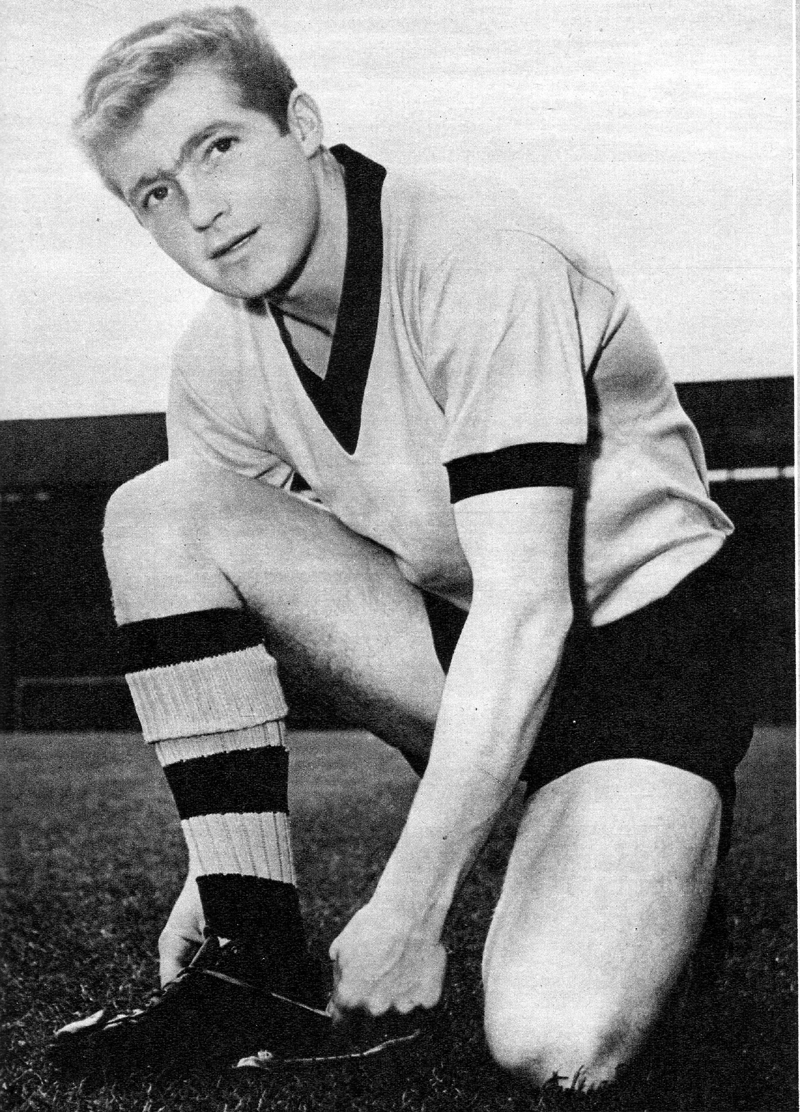
Dean Edwards, too young at 62 to even have seen him from the terraces, chipped in: “Great servant for Wolves when they were one of the most feared teams in the country.”
‘Wharty’ didn’t win more than a Second Division promotion and the 1967 USA tournament across his ten years and 242 League and cup games (with 79 goals) for Wolves but he rubbed shoulders with those who did.
He signed at Molineux at the age of 16 in 1958 and therefore had a prolonged close-up view of the man he eventually displaced on the wing, Norman Deeley. Jimmy Mullen was still around as well and the South African pair of Cliff Durandt and 1960 FA Cup finalist Des Horne ensured there were further sizeable obstacles to a place in the first team.
Wharton, having had a spell on the Notts County groundstaff overseen by Bolton-born manager Tommy Lawton, signed as a pro at Molineux on the same day that Alan Hinton did likewise. Both played in that afternoon’s third-team defeat at Bromsgrove and received the first of their dressing-room dressing-downs from Stan Cullis. “What have I done signing you two?” he said, going into full head-shaking mode.
Experienced Wolves watchers are backed up by press reports of the day in their insistence that the home crowd didn’t always give the young wingers the patience they needed.
Replacing Deeley, Mullen and Johnny Hancocks was a huge task, after all, and Hinton especially is known to have had his detractors before going on to Nottingham Forest and to double League Championship glory with Derby. Shame on those who helped see to it that this blond boyhood Wolves fanatic had to flee to the East Midlands in order to hit the jackpot.
Wharton, the second of the two close pals to break in, needed patience in negotiating the time-honoured route through the junior teams, debut day coming – with a goal – in a 2-0 home win in November, 1961 over an Ipswich side who would win that season’s title.

And here’s a thing….Deeley played his final game three weeks earlier in a defeat in Wharton’s birthplace, Bolton, and, by even bigger coincidence, ended with the Wolves career figures of 237 games and 75 goals; only five games fewer and four goals fewer than his successor would total.
Once Wharton was in, he couldn’t be shifted, much to the disappointment of the recently-signed Mark Lazarus as well as Deeley. He immediately played 27 senior games in a row, netting twice against Arsenal in his third match and another brace, at home to Carlisle, on his FA Cup debut. In a purple mid-winter spell, he struck five goals in four Division One games, including two at Cardiff.
He did, of course, have high standards to aspire to. His father, Jackie, also a fleet-footed winger, had a long League career with Plymouth, Preston, Manchester City, Blackburn and Newport and was once greeted by a devastated offspring after a proposed trial fixture.
“I remember leaving home at 1pm for this trial game (with Blackburn) and jumping on the 525 or 225 bus from Bolton, with my dad wishing me all the best as I went,” Terry told me. “By 3pm, I was home and in tears. He asked what had happened and I told him I had taken a look round the dressing room and just couldn’t handle it. I was only 4ft 11in and the lads I was up against were much taller, with hairy legs….they seemed almost like grown men. I just felt so out of place.”
Thank goodness for these moments of stage-fright and the motivational words of a parent who had himself played for Blackburn in the 1952 FA Cup semi-final. Terry was nine at the time of that last-four showdown against Newcastle and was given permission by his headmaster at the Top o’ th’ Brow School in Bolton to attend the replay at Leeds. He broke down again when The Magpies prevailed 2-1.
He was still only 19 when he became an instant success as a Wolves first-teamer. And his impact wasn’t limited to his first few months.

He started the following season with six goals in 11 games in a free-scoring side and another dynamic burst – ten goals in ten games following the resumption of football following the big freeze of early 1963 – ensured he finished second in the club’s marksmen list. The only name above him was Alan Hinton.
Daily Herald sports-writer Peter Lorenzo called for the entire Wolves forward line of Wharton, Chris Crowe, Ted Farmer, Jimmy Murray and Hinton to be selected for the European Nations Cup game against France at Hillsborough. Crowe and Hinton made it, the others didn’t and Wharton went through his career without representative honours.
His Molineux popularity soared with a hat-trick in a rearranged game against Albion that brought a 7-0 rout and he hit another, this at home to Cardiff, after the Cullis shackles had come off and been replaced by the more relaxed methods of Ronnie Allen.
Following a couple of quieter scoing seasons up to the relegation in 1965, Wharton reached double figures again in 1965-66, including another brace against poor Cardiff. There were also two penalties in an FA Cup fifth-round thriller against Manchester United that was watched by more than 53,000.
But he (and Ernie Hunt) somehow missed out in the 8-2 Molineux drubbing of Portsmouth in the November. “Eight bloody goals and I didn’t get any of them,” recalled the no 7 decades later. “We obviously didn’t have any penalties but I just hope I made one or two for the other lads.”
Terry was nerveless from the spot and had been given the job ahead of Ron Flowers, although the wing-half continued for a while as England’s penalty specialist with great success.

The 1966-67 promotion season was Wharton’s most productive in front of goal. He netted 17 times and loved the end-of-season time in Los Angeles, even if he did eventually own up on stage at the LA Wolves film launch two years ago and admit that the long-winded story he had just delivered about meeting Elvis was made up.
He had already toured North America and the Caribbean with the club and had me enthralled at his old place in Perton once when recounting how he had badly cut his ankle while defending himself in the face of an attack by team-mate Johnny Kirkham. Yes, this one IS true! Terry found himself under threat as his ‘roomie’ suffered a nightmare and lashed out at him.

What with a nasty on-field gash that required a trip to hospital in Haiti and then a smack on the healing wound when he sat next to an animated Cullis on the touchline, it was a challenging trip!
Wharton was a regular again back in the First Division and scored against Everton and Newcastle in the countdown to a bizarre dinner in a Stone hotel at which he and Francis Lee dined at one table and representatives of Wolves and Bolton did so across the room as they tried to agree some kind of swap deal.
Stoke wing-half Calvin Palmer was also the subject of deliberations but, in the event, Lee went to Manchester City and Wharton, having signed off in gold in a draw at Sheffield United in October, 1967, subsequently joined his home-town club Bolton for £70,000 as the replacement.
The two forwards were used to linking up as mates in long close-season breaks back in Bolton, where the Second Division Wanderers benefitted nicely from the presence of their record signing. He topped the 30-goal mark in around 110 appearances, became Lee’s successor as penalty king and hit a hat-trick in a win over Luton. Business as usual.

Having been overlooked by The Trotters as a boy, he predictably prospered there in the second half of his 20s before heading to big-spending Crystal Palace for a year. Debut day was in a 2-1 defeat at Molineux, Lee also having faced Wolves in his first game for City, and he soon moved in as neighbour to Alan Birchenall in the South London town of Banstead.
I was delighted to find and send a photo of Terry in Anglo Italian Cup action against Inter Milan at Selhurst Park and it wasn’t long before the travels became more extensive.
He followed what was becoming a familiar trail beaten by former League players when he headed for South Africa and played for or with Johnny Haynes, Johnny ‘Budgie’ Byrne, Gary Sprake, Alan Mullery and Colin Addison at Durban City. “We won five or six trophies in the four years or so I was out there,” he said, modestly adding with almost equal prominence the fact he was sent off in one match, too, and ordered to appear in front of a disciplinary panel.
There was still time for link-ups with Ronnie Allen’s Walsall and then Kidderminster before a 1976-77 spell as player-manager of Darlaston Town, then of the West Midlands League’s top division. Their chairman, Reg Cooper, gave him a driving job and he acquired his HGV licence – a pointer perhaps as to why he became a taxi driver in later life.

His stint as player-boss included an FA Cup pairing with Derek Dougan’s Kettering and something of a hard-luck story as they went out in a replay; yet more material for the Terry’s All Gold book on which he had been collaborating with Tim Nash on many a Saturday morning in Brewood this last couple of years.
We can but hope the publication will still see the light of day because it should be like the subject himself; an absolute gem.
*Wolves Heroes acknowledge the help and support of Charles Bamforth and John Lalley in the compiling of this tribute.


 Views Today : 67
 Views Yesterday : 774
 Views This Year : 8347